


For facility directors, procurement teams, and operations leaders, the unattended retail debate has shifted. The question is no longer whether self-service food and beverage access makes sense. It’s which format delivers the best operational and financial outcome for each location.
That’s exactly why comparing smart coolers and micro markets isn’t a matter of personal preference. It’s a strategic exercise in aligning each format to the realities of your site profile, traffic patterns, and long-term operational goals.
In this guide, we break down both models in depth — what they are, where they perform best, how they compare operationally, and how to make the right call for each location in your portfolio.
What Is a Smart Cooler?
A smart cooler is a digitally connected, self-service refrigerated unit that allows customers to grab food and beverages without the need for a cashier or attendant. Using a combination of sensors, cameras, computer vision, and AI-powered inventory tracking, these units identify what’s taken off the shelf and automatically charge the customer’s linked payment method.
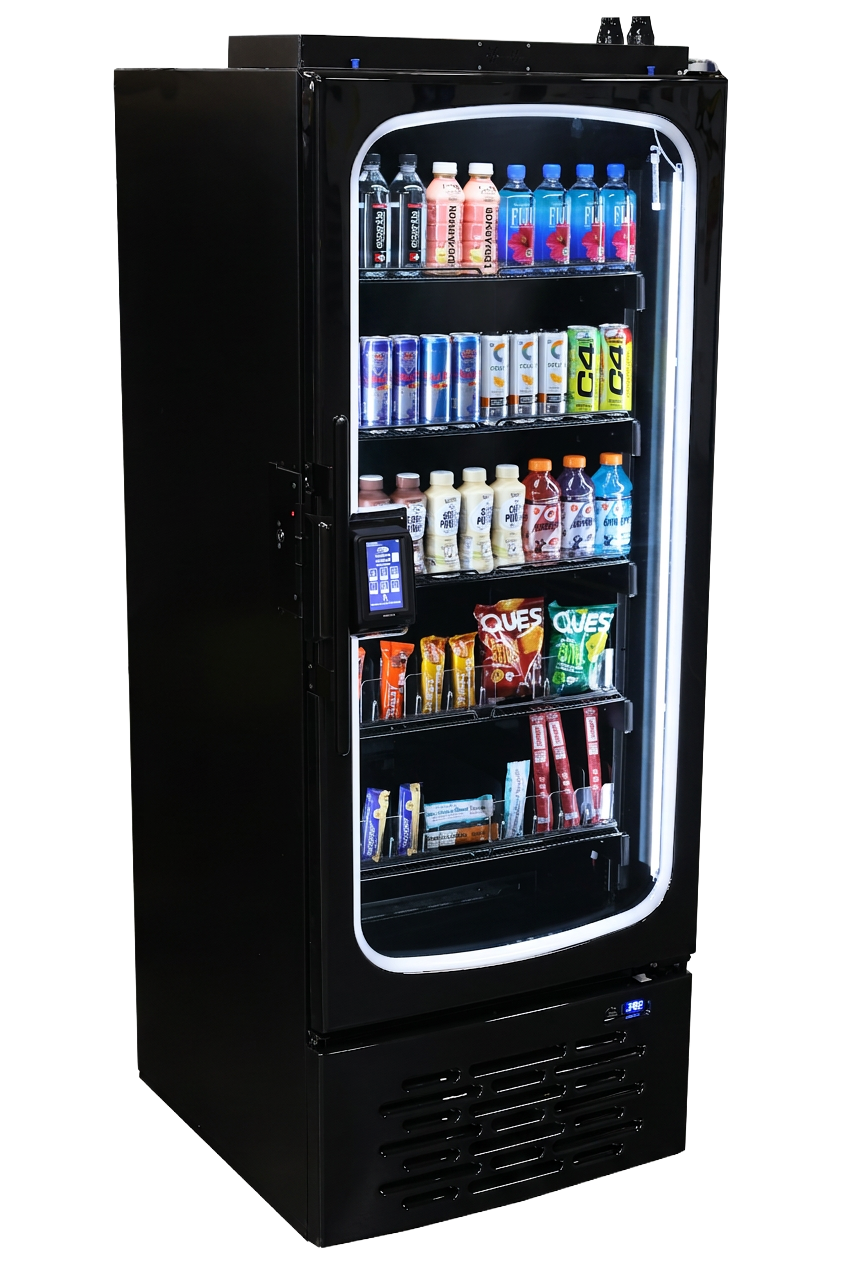
Smart coolers, such as Seaga’s Vision Elite are compact, sleek, and designed for high-speed transactions. A customer walks up, opens the door, grabs what they want, and walks away — the system handles the rest. This frictionless experience is one of the format’s most compelling advantages.
Best Use Cases for Smart Coolers
- Small to mid-size office buildings with moderate daily foot traffic
- Hotel lobbies and corridors where space is at a premium
- Healthcare waiting areas requiring quick, low-friction access
- Gyms and fitness centers catering to grab-and-go nutrition needs
- Residential apartment complexes seeking premium amenities
Micro Market Explained
A micro market is an open, unattended retail space — essentially a miniature convenience store — typically installed in a break room, cafeteria, or common area. It features open shelving, refrigerated cases, a self-checkout kiosk, and a wide variety of product categories, including hot food, fresh meals, snacks, beverages, and even personal care items.
Unlike a smart cooler, a micro market operates on an honor system reinforced by kiosk-based payment terminals. Customers browse freely, pick what they want, and scan items at the checkout station using cash, card, or mobile payment.
Best Use Cases for Micro Markets
- Transportation hubs like airport gates or train station platforms
- Large corporate campuses with high daily headcounts and diverse dietary needs
- Manufacturing plants and warehouses where workers need fast, satisfying meal options
- Universities and education facilities serving students around the clock
- Government buildings and military bases requiring robust, varied offerings
- Hospitals and large healthcare campuses with 24/7 staff and visitor access
Micro markets thrive in high-traffic, high-volume environments where variety, freshness, and dwell time allow for a richer retail experience. When customers have a few minutes to browse, a micro market can significantly outperform a smart cooler in both basket size and satisfaction.
Smart Cooler vs. Micro Market: A Head-to-Head Comparison
Space Requirements
Smart coolers occupy only a few square feet, making them well suited to small offices, corridors, and locations where space is scarce.
Micro markets typically require a dedicated 200 to 500 square foot area for shelving, refrigeration, and checkout, along with more installation planning and potential utility connections. Contact our team today for a space assessment and custom mockup.
Best fit: Smart coolers for tight spaces; micro markets for dedicated break rooms.
Product Variety and Basket Size
Smart coolers typically offer 30 to 80 SKUs, focusing on high-demand products. A curated selection supports turnover and helps reduce spoilage, but limits variety.
Micro markets can carry hundreds of SKUs across multiple categories. A broader selection serves more dietary preferences, encourages larger purchases, and can replace an off-site lunch trip.
Best fit: Smart coolers for curated efficiency; micro markets for variety and larger baskets.
Technology and Operational Complexity
Smart coolers automate checkout and track inventory in real time. That convenience comes with sophisticated hardware, potential calibration needs, and reliance on connectivity.
Micro markets use familiar barcode scanners and payment kiosks, but their broader inventory requires more extensive management and fresh-food rotation.
Best fit: Smart coolers for a frictionless customer experience; micro markets for broader inventory supported by the right software.
Capital Expenditure and ROI Timeline
Smart coolers generally require less upfront investment, although their smaller selection limits revenue potential per unit.
Micro markets require more spending on equipment, buildout, and inventory, but offer a higher revenue ceiling in busy locations. Payback may take longer, with a potentially larger return.
Best fit: Smart coolers for lower initial cost; micro markets for greater revenue potential at high-volume sites.
Staffing and Labor Requirements
Both formats operate without on-site attendants. Micro markets typically need more frequent restocking because of higher sales volume and fresh-food turnover. Smart coolers can often support less frequent service when matched to site demand.
Best fit: Smart coolers for lower service frequency; micro markets where volume supports more frequent route visits.
How to Choose the Right Format for Each Location
The smartest operators don’t pick one model and deploy it everywhere. They evaluate each site individually using a consistent set of criteria:
- Daily foot traffic: Locations with fewer than 150 people per day are often better served by a smart cooler. Above 200 to 300 daily users, a micro market begins to make strong financial sense.
- Customer dwell time: Quick stops favor smart coolers. Longer breaks create opportunities for micro market browsing.
- Product diversity expectations: If your audience expects fresh meals, hot food, and wide variety, a micro market is the right answer. If they primarily want grab-and-go beverages and snacks, a smart cooler suffices.
- Security environment: Micro markets work best in controlled-access, secure locations where theft risk is low. Smart coolers, with their locked door and automatic charge systems, can function in more open or public environments.
- Available space: When a dedicated break room or open zone exists, a micro market is a natural fit. When space is constrained, a smart cooler wins every time.
The Bottom Line: Alignment Over Preference
Both smart coolers and micro markets are powerful unattended retail solutions. Neither is universally superior — their value is entirely dependent on context.
When you match format to site profile with precision, the results speak for themselves: higher revenue per location, lower operational friction, and customers who actually use — and love — what you’ve built for them.
Ready to evaluate your locations? Start with your traffic data, walk your spaces, and let the site profile tell you which format belongs there. Contact our team today to explore your options!

